
Often, the narrative about Spain gets stuck in clichés of sun, siesta, and tapas. However, a deep dive into the data reveals a much more technical and competitive reality. Spain has transformed itself into ahigh-precision infrastructure of well-being.
Here are the 10 reasons defining the “Spain Model,” backed by data that defies common misconceptions.
10. The Invisible Highway: Leadership in Connectivity
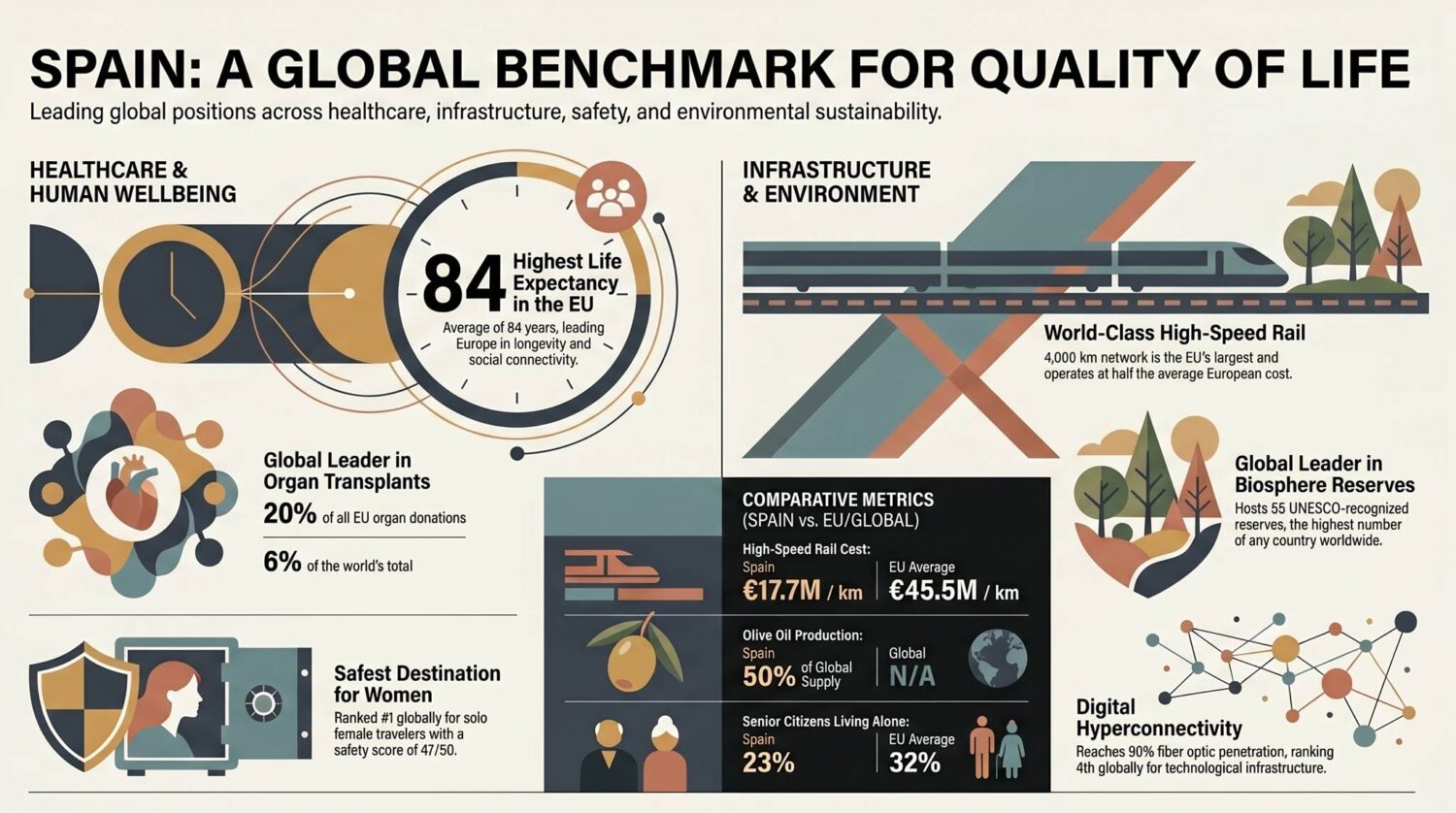
While powerhouses like Germany or Italy still struggle with the transition from copper, Spain has executed a silent revolution. According to the European Commission’s DESI Index, Spain ranks 4th in the world for fiber optic penetration, reaching 90% of households. To put it in perspective: Spain has more fiber optics installed than Germany, France, and the UK combined.
9. Custodians of History: An Active Heritage
This isn’t just about aesthetics. Spain has more UNESCO World Heritage sites per square kilometer in several of its regions than almost anywhere else. A standout is the Tower of Hercules: it’s not a ruin, but the world’s only Roman lighthouse (1st century AD) still in operation. This ability to keep millennial infrastructure functional is a unique case study in heritage conservation.
8. The Planet’s Lungs: Biosphere Leadership
Spain is the absolute world leader in UNESCO Biosphere Reserves, with 55 protected areas. It surpasses territorial giants like Russia and the United States. This isn’t just about scenery; it’s a sustainability metric that balances economic growth with the preservation of ecosystems critical to Europe’s climate regulation.
7. High-Speed Engineering: Efficiency vs. Spending
The Spanish railway network (4,000 km) is the second largest in the world, trailing only China. The key technical feat is the investment ratio: while the average construction cost in Europe is €45.5 million per km, Spain deployed its network at an average of €17.7 million, all while maintaining punctuality and safety standards above the EU average.
6. The ONT Model: Efficiency in Solidarity
Leadership in organ transplants isn’t a coincidence; it’s organizational engineering. Spain accounts for 20% of all organ donations in the European Union, despite having only 10% of its population. The “Spanish Model” of coordination is studied and replicated worldwide for its ability to maximize donation after circulatory death (DCD), a technique in which Spain is a global pioneer.
5. Real Security: A Haven of Freedom
Contrary to subjective perceptions, data from SportsCover Direct and the Global Peace Index rank Spain as the safest destination in the world for women. Scoring 47 out of 50 possible points in public safety, Spain stands in stark contrast to other neighboring countries where street harassment or nighttime insecurity are growing concerns in victimization surveys.
4. Agri-Food Superpower: The “Liquid Gold” Engine
Spain doesn’t just cook well; it feeds the world. It is responsible for50% of global olive oil production. With exports exceeding €6 billion, Spain controls the market for the core ingredient of the Mediterranean diet, far outproducing the combined output of Italy and Greece.
3. Healthcare Resilience: 7th Best in the World
According to the WHO, the Spanish system is the seventh best globally. The key contrast is its cost efficiency: Spain spends approximately 9% of its GDP on health, achieving longevity results superior to countries like the USA, which invests nearly 17% but has a significantly lower life expectancy and much more fragmented coverage.
2. The Best Place to Grow Up: UNICEF Report
A UNICEF report on child well-being ranks Spain #1 regarding thephysical environment for children. The country has the lowest levels of child morbidity related to environmental pollution among OECD countries, outperforming Nordic nations that traditionally led these rankings.
1. Victory Over Biology: Longevity and Social Fabric
Spain boasts the highest life expectancy in the EU (84 years). The most relevant factor is the social contrast: only 23% of the elderly live alone, compared to the European average of 32%. This “social cushion” and family-centric culture, combined with diet and healthcare, makes Spain a country where people don’t just live longer—they age in a supported, healthy way.
Verdict: The data doesn’t lie. Spain has achieved a synthesis of cutting-edge technology and social cohesion that sets the gold standard for life in the 21st century.