
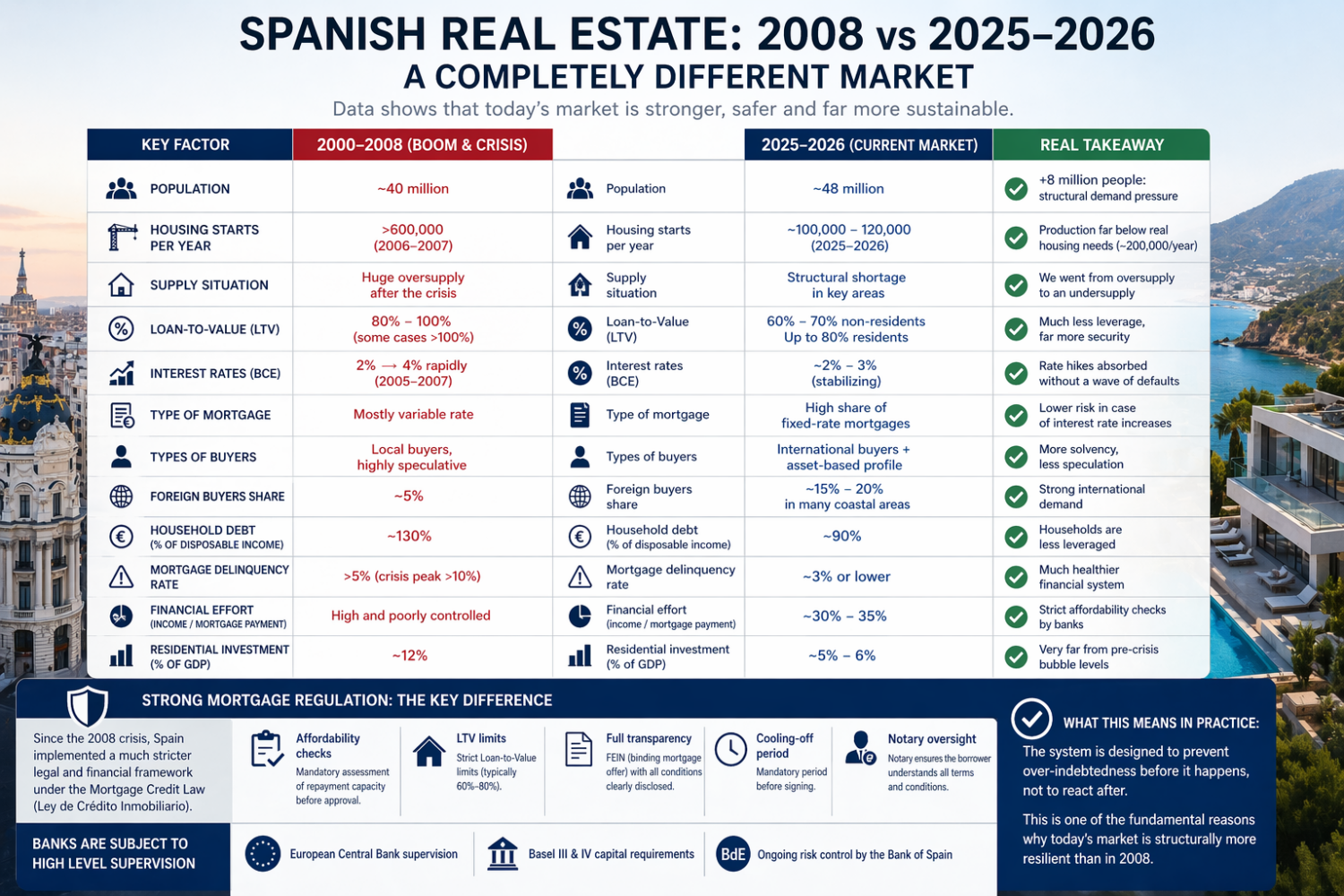
If you take a look at current rent or housing prices, it’s inevitable to feel a shiver of déjà vu.
The question is hanging in the air: Are we inflating another bubble that is about to burst?
For many, rising prices and shifting interest rates bring back bitter memories of the financial crisis that paralyzed the world nearly two decades ago. However, focusing only on the price tag is merely looking at the surface. To understand what is happening in 2026, we must look under the hood of the financial system.
The reality is that, although prices may look similar, the foundations of today’s market are nothing like those of 2008. We have moved from a market driven by speculation and uncontrolled credit to one defined by supply shortages and almost surgical banking discipline.
In this article, we break down—using real data and direct comparisons—why this time, the ending of the script is different. It’s not just optimism; it’s a matter of mathematics, regulation, and historical learning.
📊 Comparative Table: The Radiography of Change
| Key Factor | The Bubble Era (2008) | Consolidated Snapshot (2026) | Impact on Your Wallet |
| Financing (LTV) | 100%–110%. Banks lent more than the value of the home for furniture or a car. | Strict 80%. Banks require 20% in prior savings, plus costs. | Lower risk: If the price drops slightly, you do not owe more than your home is worth. |
| Risk Criteria | Lenient (Subprime). Credit to people without stable income or solid guarantees. | Prudent. Absolute priority on creditworthiness and employment stability. | Stability: Banks are no longer a “giant with feet of clay”. |
| Interest Rates | Variable (Trap). Most mortgages were linked to a volatile Euribor. | Fixed and Mixed. Broad protection against ECB rate hikes. | Peace of mind: Your monthly payment is predictable and does not depend on the evening news. |
| ECB Policy | Sudden rise (4%). Higher costs squeezed families already in debt. | Normalisation (2%). After curbing inflation, rates return to healthy levels. | Sustainability:The cost of money is balanced—neither “given away” nor “crippling”. |
| Construction Pace | 600,000+ homes/year. Massive oversupply in areas without demand. | Aligned with demand. Only what the market truly needs is built. | Real value: There is no surplus of empty homes to drive prices down. |
| Banking Situation | Risk of collapse. Tight margins and soaring defaults. | High profitability. Banks cleaned up and strengthened by rate management. | Security: Your savings are in a much more robust financial system. |
The Research Analysis: The Hard Truth
For those who fear an imminent collapse, there is one figure that changes everything: Residential Investment as a Share of GDP.
In 2007, homebuilding accounted for almost 12% of Spain’s GDP, which meant that if construction slowed, the country would sink. In 2026, that weight has been cut in half, standing at a healthy 5%–6%. Today, Spain’s growth does not depend on laying brick upon brick at any cost, but on a diversified economy and high-tech infrastructure.
Verdict: We are not in a credit bubble; we are in a market with scarce supply against real, creditworthy demand. The 2008 storm taught us to build shelters of stone, not paper.